
From Biofeedback to Biosensing
1978 · BIOFEEDBACK ASSOCIATES OF CALIFORNIA
ShadowMaker’s story began decades before the company existed.
In 1978, ShadowMaker co-founder Violetta Georgiou co-founded Biofeedback Associates of California (BAC), a medical clinic in San Jose, California. BAC used surface electromyography (sEMG) biofeedback to help people recognize and change patterns of muscular tension associated with repetitive strain injuries, temporomandibular disorders, chronic pain, stress, and rehabilitation.
Violetta and BAC co-founder Dennis developed an approach they called Muscle Learning Therapy. Sensors measured muscle activity, immediate feedback made otherwise invisible tension visible, and progressively more complex tasks helped patients carry what they learned into everyday movement.
BAC worked with individuals and organizations throughout Silicon Valley, including Apple Computer, Hewlett-Packard, Chevron, the San Jose Police Department, and the San Francisco 49ers. Its work established a principle that still guides ShadowMaker today:
When people can perceive their physiology, they can learn to change it.


ShadowMaker co-founder Alexander Grey encountered that principle personally. As a child, he was treated at BAC for temporomandibular joint dysfunction using sEMG biofeedback.
By age eight, he had learned not only how to control the muscular tension contributing to the condition, but also how sEMG equipment worked, how electrode placement affected signal acquisition, and how physiological signals could become useful feedback.
That early experience shaped the work that followed.
2005 – 2015 · Somaxis
In 2005, Alexander began developing a new generation of wearable sEMG sensors. In 2008, he co-founded Somaxis, where he served as CTO and principal system architect and led development of the Cricket wearable EXG platform.
Cricket was designed to acquire sEMG, ECG, and EEG signals wirelessly while addressing the problems that often limit electrophysiology outside controlled environments: movement artifacts, inconsistent electrode contact, comfort, and repeatability.
Alexander developed dynamic-gain electronics, signal-processing methods, electrode configurations, and wearable form factors intended to preserve signal quality during real movement. Cricket systems were subsequently used by physical therapists, ergonomists, biofeedback practitioners, researchers, and individuals around the world.
Somaxis transformed the original BAC principle (“physiology is trainable”) into wearable technology that could operate beyond the clinic.
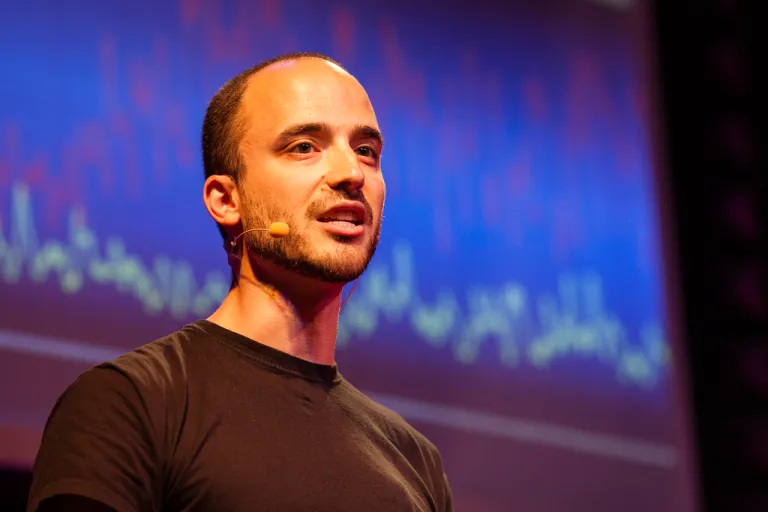
In 2012, Alexander presented the technology and its potential applications at TED in New York City.
Patented Foundations
The work at Somaxis also produced a portfolio of issued U.S. utility patents covering wearable electrophysiology, sensing architectures, and related applications. Those inventions created part of the technical and intellectual-property foundation that would later carry forward into ShadowMaker.
2015 · BODYMETRICS
In 2015, Alexander helped integrate Somaxis Cricket sEMG and motion sensors into BodyMetrics, an interactive exhibit at The Tech Museum in San Jose.
BodyMetrics combined physiological signals from Cricket with EEG and interactive behavioral data to explore relationships among the body, behavior, and emotional state. The exhibit operated for several years and generated a substantial multimodal dataset connecting human experiences with measurable physiological responses.
The project pointed toward a larger possibility: wearable biosignals could do more than measure movement or muscle activity. Combined with context and other data sources, they could help interactive systems understand how people were responding.
2020 – PRESENT · SHADOWMAKER
As Somaxis shifted toward intellectual-property licensing, Alexander continued exploring the intersection of wearable sensing, movement, emotional response, and interactive systems.
In 2020, Alexander and Violetta reunited to form ShadowMaker in Washington State. Their goal was to bring together lessons accumulated across clinical biofeedback, wearable EXG engineering, multimodal data, affective computing, and interactive entertainment.
That work became Atopia: a modular wearable biosensing platform designed for smart shirts, textiles, accessories, and other body-connected products. Its applications now extend across gaming, sports and fitness, health, and emotionally responsive AI.
ShadowMaker publicly introduced its first integrated platform and applications in 2026. The technology has changed dramatically since BAC began using sEMG in 1978, but the underlying purpose remains remarkably consistent:
Evidence over hype.
BAC taught us to measure what matters and close the feedback loop: detect, reflect, adapt.
Somaxis taught us to engineer for the movement, noise, and variability of real life.
ShadowMaker brings those lessons together in a biosensing platform built to understand how people move, respond, and feel.